Overview
Led by Academician Yong-Bin Yang, an internationally renowned scholar in structural mechanics and dynamics, the Bridge and Rail Vibration Lab (BRVL) is located in the Wugui Mountain New Laboratory Complex on Campus B of Chongqing University. With a total floor area of approximately 1,900 m², BRVL is an important part of the National Key Laboratory of Mountain Civil Engineering Safety and Resilience.
Aligned with the national strategy for building China into a transportation power, BRVL focuses on the safety-oriented operation and maintenance of widely deployed infrastructure, especially small- and medium-span bridges. With safety and resilience as its core goals, the lab advances research on dynamic evolution theories, intelligent monitoring technologies, and life-cycle decision-making systems, supporting long-life, safe, and intelligent bridge management and maintenance.
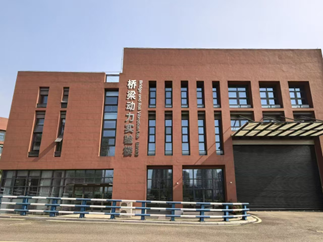
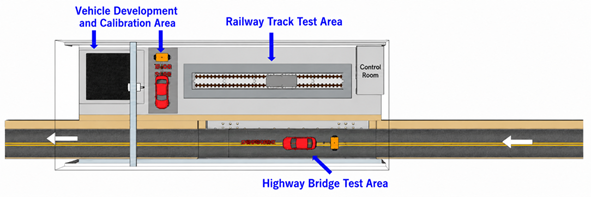
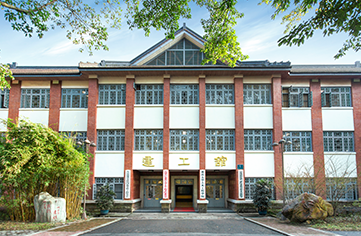
BRVL building and schematic layout of the highway and railway bridge vibration testing areas.
Global Leadership
BRVL hosts the world’s first full-scale bridge dynamic testing platform. The platform supports research in the following areas:
· Experimental studies on highway/railway bridge–vehicle coupled dynamics and performance evolution mechanisms
· Lightweight, rapid inspection and intelligent monitoring technologies for small- and medium-span bridges, including the vehicle scanning method
· AI-enabled bridge health diagnosis, assessment, and decision-making based on big-data features and benchmark models
Platforms and Functional Areas
1. Highway Bridge Testing Area
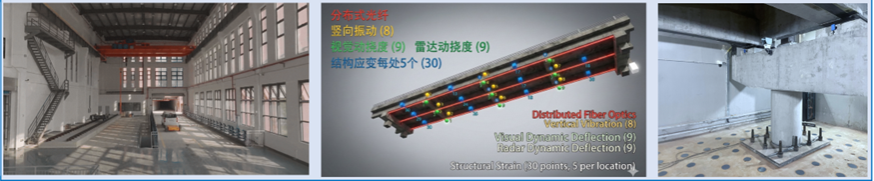
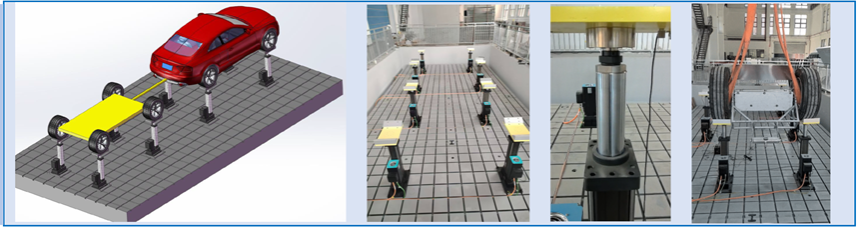
A 1:1 full-scale bridge model (25 m long and 7 m wide), consisting of a simply supported bridge with three precast T-girders and movable piers. The first vertical bending frequency is 5.2 Hz and the torsional frequency is 6.4 Hz. The bridge is equipped with multiple types of measurement sensors, including response, vision, temperature, and humidity sensors. It supports controlled damage simulation, data acquisition, and intelligent identification research.
2. Railway Track Testing Area
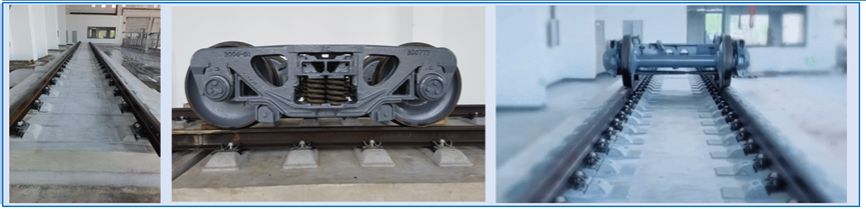
A 1:1 standard track model (25 m long) with a CRTS bi-block ballastless track slab and a Type K2 bogie. It is used for research on train–track coupled vibration and force transmission mechanisms, as well as validation of intelligent identification technologies for track structures.
3. Vehicle Dynamic Calibration System
A spacing-adjustable, eight-post electric actuator system with a single-axle load capacity of 5 tons and a maximum excitation frequency of 50 Hz. With multi-axis synchronous control, the system is used for calibration, optimization, and durability testing of various measurement vehicle systems.
Core Technologies and Equipment
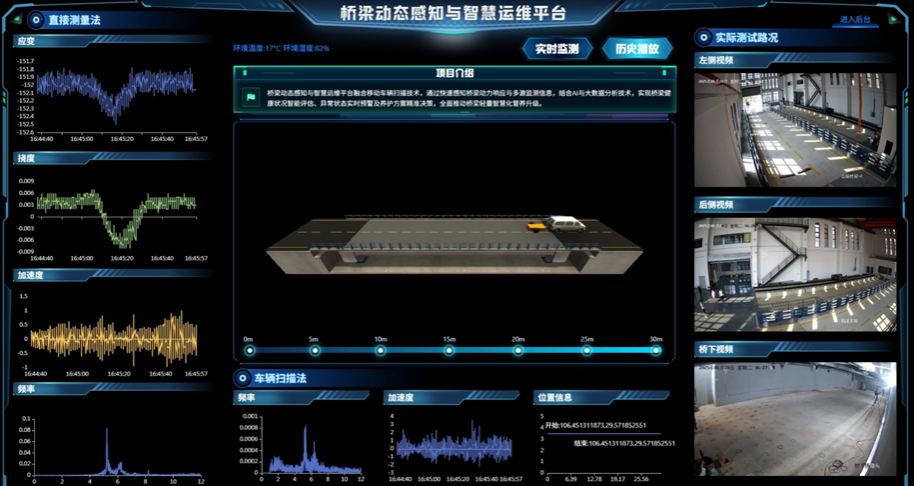
Centering on the vehicle scanning method, BRVL has independently developed a mobile inspection vehicle system and a frequency-free measurement vehicle system. Using vehicle-mounted vibration sensing, navigation and positioning, and data inversion algorithms, the systems can indirectly perceive bridge conditions and rapidly evaluate bridge performance in outdoor environments.
Relying on the full-scale bridge model, scaled test devices, and a digital twin platform, BRVL is building a large-scale bridge damage data sample library. By integrating AI methods such as transfer learning and federated learning, the lab is developing large models for health assessment and decision-making for small- and medium-span bridges, driving the transition of bridge management and maintenance from experience-driven to data-driven practice.
BRVL has also developed a bridge dynamic sensing and smart operation and maintenance platform that receives inspection-vehicle data in real time and supports online analysis and decision-making. Additional facilities, including a dynamic loading test platform for long-span suspension bridges and scaled vehicle–bridge coupled test devices, provide high-quality experimental infrastructure for smart monitoring, mechanism studies, and method validation for long-span bridges. These platforms also support undergraduate and graduate innovation practice, structural dynamics teaching, and exploration of AI-enabled education.
Achievements and Applications
Guided by the principle of addressing real engineering challenges, BRVL continues to deliver high-level outcomes in bridge design, construction, operation, and maintenance. The lab has led or participated in the development of multiple national, industry, and association standards, published several monographs, and obtained more than 50 authorized invention patents.
Its achievements have received honors including the First Prize of the Chongqing Science and Technology Award, the Special Prize of the China Highway & Transportation Society, the Li Guohao Original Bridge Technology Award, and the Lifetime Achievement Award of the American Society of Civil Engineers. BRVL technologies have been applied to major projects such as Taipei Yuanshan Bridge, Danjiang Bridge, Chongqing Qiansimen Bridge, Dongshuimen Yangtze River Bridge, and Zhangjinggao Yangtze River Bridge, and have supported major railway bridge projects including span-length optimization for the Zhengzhou–Jinan and Xiamen–Zhangzhou high-speed railway bridges.
Vision
BRVL will continue to address major national needs, deepen research on and engineering translation of Academician Yong-Bin Yang’s original technical system, and develop itself into an incubator for frontier bridge technologies and a platform for cultivating outstanding innovative talent. The lab is committed to providing stronger support for safe and resilient infrastructure and the development of a transportation power.
Visitors, partners, and collaborators are warmly welcome.


 |
CH
|
CH



 Add: No. 83 Shabeijie, Shapingba, Chongqing,
400044, China
Add: No. 83 Shabeijie, Shapingba, Chongqing,
400044, China  Tel: +86(23)65120720